

Why most Canadians will keep daylight saving time changes as B.C. stops – National
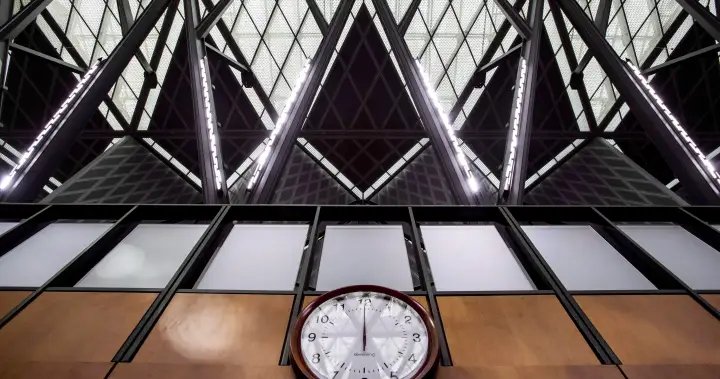
As clocks spring forward an additional hour for daylight saving time on Sunday, British Columbia will be doing so for the last time.

But the spotlight is now turning to why other provinces will keep changing their clocks.
“It’s a collective action problem where there’s no incentive for any place to move,” said McMaster University political scientist Peter Graefe in an interview.
“Maybe it does take one place to move and it will have some impact in having other places saying, ‘Look, the sky didn’t fall, maybe we’ll try it as well.”
British Columbia’s Premier David Eby announced on Monday the province will be adopting a permanent year-round daylight saving time, meaning that there will no longer be any seasonal time changes in that part of Canada.
“When we change our clocks twice a year, it creates all kinds of problems,” Eby said when announcing the new policy.
“Kids get up at the same time, even though the clocks changed. Dogs get up at the same time, even though the clocks changed. Parents lose sleep. Kids lose sleep. And even people without kids or parents, they’re losing an hour of sleep … So what we see is more car accidents and people not feeling well and impacts that have a huge, unnecessary impact on the lives of British Columbians.”
B.C. has been working towards getting rid of daylight savings time for years, as former premier John Horgan tried numerous times to do so, with no success.
In 2019, the province passed legislation to create a Pacific Time zone where the time would remain the same all year, as a result of the most popular public consultation in B.C. history, in which 93 per cent of people indicated support for permanent daylight saving time.
What are other provinces doing?
The Ontario legislature passed a bill in November 2020 that put an end to time changes and keep the province permanently on daylight time.
But the bill was relying on Quebec’s government and New York State passing similar laws.

In March 2022, Ontario Premier Doug Ford stated that Ontario would “eventually” scrap the bi-annual time change.

Get daily National news
Get the day’s top news, political, economic, and current affairs headlines, delivered to your inbox once a day.
“I think we’ll eventually stick with daylight saving time and just be like the rest of North America,” he said at the time.
In Alberta, 50.2 per cent of Albertans voted towards keeping daylight saving time during October 2021’s municipal elections, a margin of just 2,834 votes ahead.
Global News reached out to the remaining provinces, but those that responded appeared firm no change is coming for now.
Ontario, Quebec, New Brunswick, Manitoba and Nova Scotia all told Global News there were current plans to change how they observe daylight saving time.
Ontario and Nova Scotia said in emails regional alignment will be needed, with the former referencing its 2020 legislation.
Quebec also signalled no change, but said it recognizes Quebecers’ desire to end the change and is consulting with experts.
A shift could be possible in Alberta, though, with Finance Minister Nate Horner saying Tuesday it could be revisited.
“I think we better wait until we hear all the facts,” he said. “Albertans really wanted to understand which time we were going to change to and why (in the 2021 vote) and so I think we’ll have to have that conversation and going through that rationale, but it’s probably coming towards us.”
Newfoundland and Labrador and Prince Edward Island did not respond by publication.


Why experts say there’s no easy fix
Rebecca Robillard, co-chair of the Canadian Sleep Research Consortium, said that adjusting to the change of time is a “more complicated issue than people think.”
“It’s not just related to an hour of sleep; it actually disrupts the alignment between the biological clock and the natural cycle of the sun,” she said. “It’s super important because that biological clock regulates our sleep cycle, but also most functions across the body and brain.”
Robillard also said that as a result, this change affects “the timing we are releasing different hormones, the way in which we regulate insulin, metabolism, temperature,” among other things.
“It’s not just a question of sleep, because that biological clock is implicated and the regulation of so many different neurological functions across the body, we see ramifications in terms of more sleepiness, mood swings, difficulties concentrating, memory problems, increased rates of stroke and heart attacks, complications with the immune system, digestive and kidney problems and even pregnancy complications,” she said.

However, Patricia Lakin-Thomas, a professor in the biology department at York University, cited that the decision out of B.C. has its downsides.
“Everybody loves the idea when you first announce it, great, we get more light, but in the winter, we just hate it,” she said.
“We also know that in addition to the inconvenience and danger of getting out in the dark, we know that we need morning light. That’s because our circadian clocks, our controlling clock in our brain, is reset by light through our eyes. Most people’s clocks run a little slow, we drag a little longer than 24 hours, so what we need is morning light to reset our clocks, speed them up a little so we are back in step with the 24-hour cycle.”
Dr. Joanna Fong-Isariyawongse, a neurology professor at the University of Pittsburgh, told Global News that keeping standard time over daylight time is the sound choice.
“The worst thing we can do is keep switching twice a year and if we’re going to pick one time and stay there, the medical consensus is clear — we need to keep our clock permanent in standard time,” Fong-Isariyawongse said.
“When our biological clock is aligned with the sun, you want the sun to be on top of our head at noon (because) we see better health outcome and better safety outcome(s).”